Date Night Nails: Ready in Five Minutes
Date night nails should feel special without taking your whole afternoon. Press ons go ...
Read more ›

Two sets of press on nails can look identical in a photograph and behave completely differently on your hand. One lasts a weekend and goes in the bin. The other holds for three weeks, comes off intact and goes back on next month.
Looking for a set? Browse handmade press on nails from Aurelle Beauty, salon look in about 5 minutes.
The difference is how they were made. Here is what actually separates handmade from mass-produced, how to tell from a listing, and why it decides what a set costs you over a year rather than at the checkout.
Mass-produced sets are injection-moulded in volume, printed or dipped in a single pass, and packed by machine. A set is a handful of cents of plastic and a few seconds of process. The economics require thin material and generic shapes, because both are what make high-volume moulding cheap.
Handmade sets start from the same tips but the work happens afterwards, by a person: the shape is refined individually, the surface is built in layers and cured between them, the cuticle edge is filed to sit flush, and the set is finished and checked as a set. Twenty to forty minutes of someone's attention, per set.
That is the whole difference, and everything below follows from it.
Pick a nail up. A mass-produced one flexes easily between two fingers and feels like packaging. A handmade one has body and resists.
This is the tell that matters most, because thickness is what survives a removal soak. Thin acrylic cracks in warm water, which makes the set single-use whatever the packaging claims.
Look at the base of the nail, not the tip. A handmade set has a curved cuticle edge shaped to sit flush against skin. A moulded one is close to straight and often blunt, so it bridges — leaving a visible dark line where light gets underneath.
That line is what makes nails read as fake from a metre away. Not the length, not the colour.
Looked at end-on, a nail should curve across its width to match the curve of your nail bed. Mass-produced sets are flatter, because flat releases from a mould more easily. A flat nail on a curved nail bed only makes contact in the middle, which halves the glue's grip and is why those sets lift at the corners.
Surface-printed designs wear off at the tips within days — you will notice it on your index fingers first. Layered and cured finishes are sealed under a top layer and survive the full wear and a removal soak.
Chrome, glazed and pearl finishes show this most clearly. Done properly they stay bright for weeks. Printed, they go dull in about a week.
Lay the whole set out. A handmade set is uniform — same thickness, same finish, same curve. A cheap set commonly has two or three nails with a flaw, a thin patch or a different tone, because nothing was checked individually.
| Mass-produced | Handmade | |
|---|---|---|
| Typical price | $5 – $20 | $30 – $60 |
| Thickness | Thin, flexes easily | Substantial |
| Cuticle edge | Straight, often bridges | Curved, sits flush |
| C-curve | Flat | Matched to the nail bed |
| Finish | Surface print | Layered and cured |
| Typical wear | 1 – 5 days | Up to 4 weeks |
| Survives a removal soak | Rarely | Yes |
| Sizing | Generic moulds, often no size guide | Size profiles with published mm measurements |
A $12 set worn once, replaced fortnightly, is about $310 a year. A $39 handmade set worn three times before it is retired is about $350 a year — roughly the same.
But the $12 set gives you five days of wear at a time and looks it, and the $39 set gives you up to four weeks and does not. Per day of actually wearing nails you like, the handmade set is several times cheaper, and that gap widens every time you get an extra wear out of a set.
The cheap option only wins if you genuinely want nails for one evening and never again. For anything ongoing, buying at the bottom of the market is the expensive choice. Our Australian price guide works through all four market tiers.
It is worth being concrete about where that time goes, because "handmade" is a word that gets used loosely.
Shaping, per nail. A moulded tip comes out of the mould in a generic shape. Getting a true almond — with the taper starting in the right place and the tip point centred — means filing each nail individually. Every nail in the set, and the difference between a real almond and an approximate one is visible from across a room.
The cuticle line. The base of a moulded tip is cut straight. Filing it into a curve that matches the shape of a real cuticle takes a minute per nail and is the single biggest contributor to a set looking like a manicure rather than like nails stuck on.
Layering and curing. A colour built in two or three thin cured layers is deeper, more even and far more durable than one thick coat. Each layer needs curing before the next. This is what stops a finish going patchy at the tips after a week.
Sealing. A top layer over the design is what makes the finish survive warm water. It is also what makes chrome and glazed finishes hold their brightness rather than dulling.
Checking the set. Laying out the whole set, matching tones, discarding anything with a thin patch or an uneven edge. Nobody does this at volume, which is why cheap sets so often have two or three nails that are noticeably off.
This is the part that makes the price difference disappear, so it is worth doing properly.
| $12 mass-produced | $39 handmade | |
|---|---|---|
| Wear per application | 1 – 5 days | Up to 4 weeks |
| Times it can be worn | Usually 1 | Several, with careful removal |
| Days of wear per set | ~4 | ~42 across three wears |
| Cost per day of wear | ~$3.00 | ~$0.93 |
Basis: illustrative, using a typical $12 mass-produced set against our $39 standard sets at two weeks of wear per application. Reuse depends on removal technique and is not guaranteed.
Three times the sticker price, roughly a third of the running cost. That inversion is the whole argument for buying handmade, and it only holds if you soak sets off rather than pulling them — which is also the habit that keeps your natural nails in good condition.
Two situations, and they are real. A costume or themed event where you want something outrageous for one night and do not care what happens to it afterwards. And a first experiment where you are not sure the format is for you at all — though even then, one good set tells you far more than three cheap ones, because a bad experience with a thin poorly-sized set tells you nothing about press ons and everything about that set.
Outside those, the cheap tier is solving a problem most people do not have.
No, and the distinction is worth knowing because the prices are very different.
Handmade sets are built by hand in standard sizes — you choose the size profile that matches your measurements and file to fit if needed. Custom sets are built to measurements you supply, cost $70 to $150 or more, and typically take two to four weeks.
For the large majority of people a handmade set plus two minutes of filing gets you to the same place for a third of the price and none of the wait. Custom earns its premium for unusual nail shapes and for bridal, where an exact fit on the day matters.
A few things surprise people opening a hand-finished set for the first time, particularly if they have only bought from a chemist before.
Each nail is shaped for a specific finger. An Aurelle set is ten nails matched to your size profile — XS, S, M or L — one for each finger. Lay them out in order against your fingers before you glue anything.
There are no spares, so removal matters. Ten nails means every one counts. Soak them off rather than pulling, and store them flat in the tray between wears.
They may still need a little filing. Handmade is not the same as custom. A minute or two filing the sides for width or the tip for length is normal, and it is how a pre-made set becomes a fitted one.
The finish looks deeper in person than in photographs. Layered and cured colour has depth that flat photography does not capture, which is why so many product photos undersell this tier.
Thickness, a curved cuticle edge, a proper C-curve, a sealed rather than printed finish, and consistency across the whole set. A side-on photograph will tell you most of it.
If you wear them more than a couple of times a year, yes — they are thick enough to be reused, which is where the saving lives. For a single costume night, no.
Thin material, generic moulds, printed finishes and no individual checking. Those choices are what make high-volume production cheap, and they are also what make the set single-use.
Occasionally, but thin sets tend to crack during the warm-water soak that removal requires. In practice most are single-use.
Yes. A matched C-curve and a flush cuticle edge mean more contact area for the glue, which is what holds a set on. A flat nail on a curved bed grips in the middle only and lifts at the corners.
Handmade, layered and cured, sized XS to L, thick enough to take off and wear again. That is what turns press on nails from a single-use purchase into a year of manicures for the price of two salon visits.
Ready to try a set? These are popular picks from our range:
Date night nails should feel special without taking your whole afternoon. Press ons go ...
Read more ›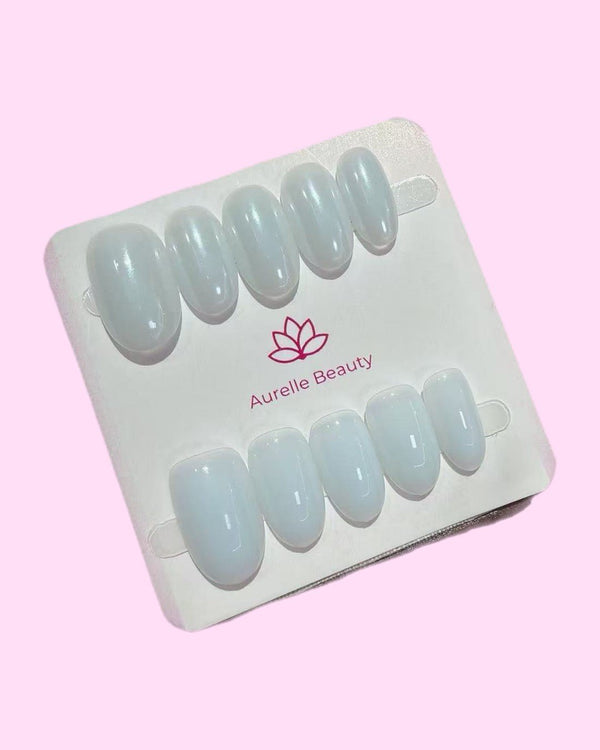
Baby shower nails are all about soft pastels and sweet details, whether you're the gues...
Read more ›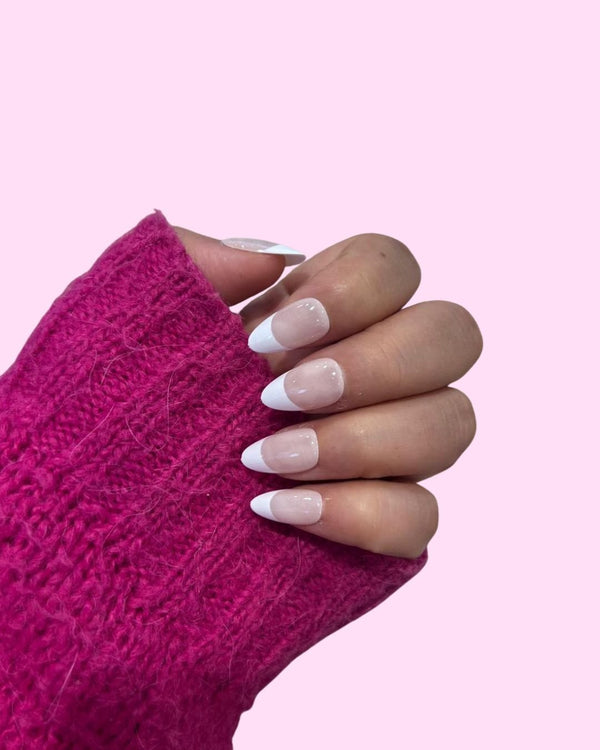
The right nail shape can make fingers look longer and slimmer. Here's what works best f...
Read more ›Shop the sets in this guide
Free AU shipping over $99
 Luxe Daisy 3D – Handmade, Medium Almond
 Floret Dream 3D Floral – Handmade, Long Almond
★ 10,000+ reviews · Handmade · Ships from Australia
Watch
Handmade vs Factory Press On Nails: Can You Tell?