Beach and Holiday Nails: Designs That Handle Sand, Salt and Sunscreen
Holiday-proof press on nails: the lengths and finishes that handle saltwater, sunscreen...
Read more ›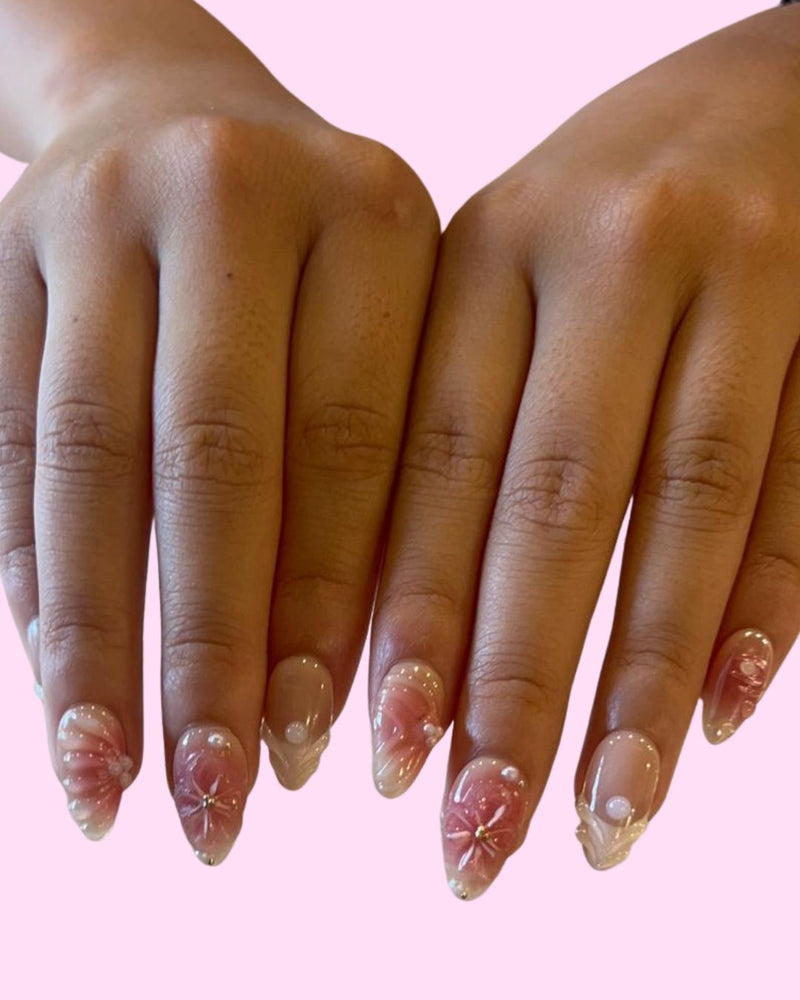
Let us know your email address
You're in! 🎉
Check your inbox for your 10% off code.


An Australian summer is not a northern one with the dates moved. It runs through Christmas, New Year and the whole holiday period, it is hot enough that hands are permanently visible, and it involves considerably more saltwater than a European July.
So the nails that suit it are not simply "bright". Here is what is actually defining Australian nail work going into summer 2026/27, and how to wear it.
The clearest signal from Australian nail artists is a move away from flat colour and toward finish and texture. Working artists discussing the direction have named airbrushing, chrome, cat-eye gels, inks and flocking alongside 3D sculptural detail, and described the general shift as "textured and layered" work.
On colour, the direction is muted rather than bright: washed-out pastels, muted blues and greens, tarnished silvers, mauves and bruised pinks, matcha and moss tones. One Melbourne artist summarised it as "less seasonal colour cycles, more warmth, imperfection and clashy palettes".
Two things worth drawing out of that. First, the traditional idea that summer means neon and winter means dark is genuinely fading — people wear what suits them rather than what the season dictates. Second, clear, sheer and milky bases with fine detail over the top are doing a lot of the work, which is the opposite of the saturated summer brights of a decade ago.
The most-worn summer look, and the most practical. Warm-toned nudes sit well against tanned skin where cool pinks can look washed out, and they suit every setting from the beach to a Christmas lunch. Go one or two shades deeper than your skin — a nude lighter than your hand disappears in strong daylight.
Cool-looking in the most literal sense. A milky white or sheer wash reads as fresh and immaculate against sun-warmed skin, and it works at the short lengths that summer favours. This is the base most of the fine detail work sits on.
The summer-appropriate member of the chrome family. Iridescent rather than mirrored, and it catches natural light beautifully — which matters, because Australian summer photographs are taken outdoors in very strong light. More on the distinctions in our guide to chrome and glazed finishes.
Not the sugary pastels of previous summers — muted, slightly dusty versions. Sage, dusty lilac, faded butter, chalky blue. They read as considered rather than sweet, and they suit the linen-and-neutrals register of an Australian summer wardrobe.
The enduring summer shades, and the ones that photograph best in bright light. Warm enough to flatter a tan, saturated enough not to vanish outdoors.
Where the textured direction meets everyday wearability: a milky or sheer base with a micro French, a fine line, or small abstract detail on one or two nails. Interesting up close, quiet from a distance.
Most nail trend writing is northern-hemisphere writing, and it does not transfer. Three reasons worth naming.
The seasons are inverted, but the retail calendar is not. The "autumn shades" arriving in your feed in September are landing as our spring begins, and the "summer brights" arrive as we head into winter. Following an international feed means wearing burgundy in October and coral in June.
Christmas falls in the middle of summer. Every northern Christmas nail guide assumes snow, knitwear and darkness at four o'clock. An Australian Christmas is a backyard, a salad and thirty degrees, and the nails that suit a Vermont December look strange at a Sydney lunch.
The light is different. Australian summer daylight is genuinely harsher than most of the northern hemisphere's, and it flattens pale colours against skin in a way indoor photography never reveals. A shade chosen from an overseas product photo shot in soft studio light will often read quite differently on a beach in January.
The practical upshot: choose for the conditions you are actually in. Warmer, slightly deeper, glossier, and shorter than the international feeds suggest.
The most useful thing to take from where nail work is heading is that finish is doing more work than colour now — and that is good news for anyone who does not want to commit to a shade.
A milky base with a pearl finish reads differently in morning light, under a restaurant lamp and in a photograph. A flat pastel reads the same everywhere. That variability is the entire appeal of the textured and layered direction, and it is why chrome, glazed, cat eye and fine detail have stayed relevant across several seasons while individual colours have come and gone.
It also means a smaller wardrobe goes further. Two sets in the same neutral, one glossy and one glazed, cover more situations than two sets in different colours — because the finish shifts the register while the shade stays reliably flattering.
If you want one thing to try this summer that is genuinely current rather than perennial, it is a milky or sheer base with something fine over it: a micro French, a thin line, or small abstract detail on two nails. That specific combination is where a lot of Australian work is sitting.
| Occasion | Look | Length |
|---|---|---|
| Everyday, work | Warm nude, glossy | Short |
| Beach and pool | Warm nude or coral, glossy | Short, rounded |
| Christmas lunch | Milky base, fine gold detail | Short to medium |
| New Year | Chrome, cat eye or 3D detail | Medium |
| Summer wedding as a guest | Nude a shade deeper, or a fine French | Medium |
| Holiday evenings | Glazed or pearl | Medium |
| Australia Day, backyard events | Milky or sheer | Short |
Go shorter. Summer involves swimming, beaches, more time outdoors and generally more hand use. Short sets take less leverage and survive it better.
Rounded shapes. Almond, round and squoval have no corners to catch on towels, swimwear or a beach bag. Short and rounded is also the direction Australian artists have been naming — practicality without giving up the look.
Glossy over matte. Matte marks easily and photographs flat in strong light.
Deeper than you think. Bright sun flattens pale shades. A nude that looks elegant indoors can disappear entirely outdoors.
Expect shorter wear. Sunscreen, salt and warm water all work against a glue bond. Our holiday guide covers getting a set through it.
Your surface tone shifts with sun exposure; your undertone does not. What changes is the depth you need.
Cool undertones work with milky white, dusty lilac, chalky blue, sheer pink and silver-toned finishes. In summer, go a step deeper than your winter shade.
Warm undertones work with caramel, coral, terracotta, golden nude and bronze or gold finishes. These are the shades that gain the most from a tan.
Neutral undertones can wear most of the above, and milky white is the safest default across the board.
A practical point: if you tan meaningfully over summer, the nude that suited you in September will be too pale by January. Owning two depths in the same family is more useful than owning two different colours.
The Australian summer's two biggest events both fall in the middle of it, and both need a different register.
Christmas here is a summer event. Backyard lunches, seafood, thirty-degree afternoons. Deep reds and greens read as imported; warm nudes, milky bases with fine detail, and gold accents suit the actual day better.
New Year takes the year's boldest set. Chrome, cat eye or fine 3D detail. It is one night, usually photographed, and it is the moment to wear something you would not wear to work.
Both are worth buying for in November rather than late December, when everything ships slowly.
Summer is the hardest season for adhesion, and a few adjustments make a real difference.
Rinse after sunscreen. The highest-value habit of the season. Sunscreen oils migrate under the free edge straight into the bond, and reapplying every two hours for weeks is what ends most summer sets.
Dry your hands properly after swimming rather than letting them air dry. Standing water at the sidewalls is the damage, not the swim itself.
Apply in the evening. Glue needs two hours away from water, and a summer afternoon rarely provides it.
File to a comfortable fit, not a tight one. Hands swell in heat, and a set that fitted exactly in the cool of the morning can press uncomfortably by mid-afternoon.
Keep a tube of glue in your bag from December to February. A lifted nail on a beach day is a thirty-second fix if the glue is there.
Expect around a week from a set during a beach-heavy stretch, against three to four weeks in an ordinary working week. That is the conditions rather than the product, and planning for it beats being disappointed by it.
Three sets covers the season comfortably.
Each worn a few times across the season, that is under $120 for a summer of nails, and none of them requires an appointment in the busiest three months of the year.
Warm nudes and caramels, milky and sheer bases, washed-out pastels, coral and terracotta, and glazed or pearl finishes. Australian nail artists have also named muted blues and greens, mauves, tarnished silvers and matcha tones among current directions.
Less so. The direction Australian artists describe is muted and textured rather than saturated — washed-out pastels and finish-led work rather than brights.
Short. Swimming, beaches and more hand use all favour it, and short rounded shapes are the practical direction anyway.
Warm nudes, caramel, coral, terracotta, gold and bronze finishes, and milky white. Very pale cool nudes tend to look washed out against a tan.
Warm nudes, milky bases with fine gold detail, or a soft French. Deep reds and greens read as imported for a thirty-degree day.
Go one or two shades deeper than you would indoors. Bright daylight flattens pale shades against skin.
Short, rounded, warm-toned and glossy. Three sets covers the whole summer, and none of them needs a booking.
Handmade, reusable, dispatched from Australia.