Press On Nails for Short or Wide Nail Beds: Finding Your Fit
If every set gapes at the sides or digs into your sidewalls, your nail beds are wider t...
Read more ›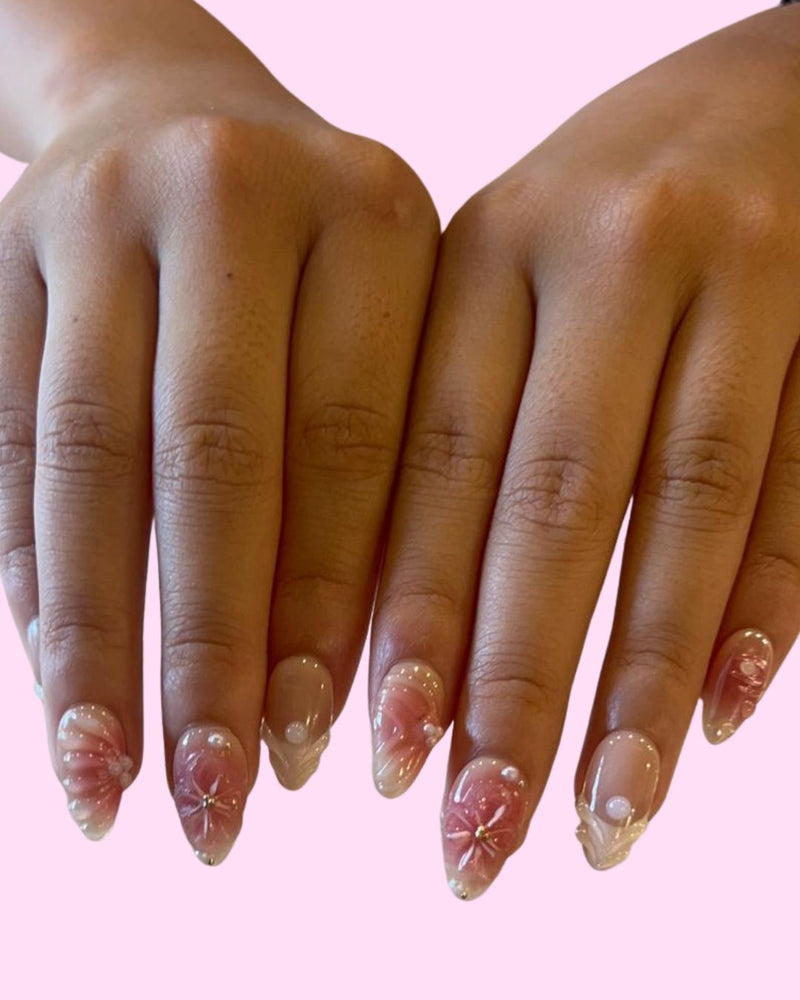
Let us know your email address
You're in! 🎉
Check your inbox for your 10% off code.


3D press on nails are the one category where press ons genuinely beat a salon appointment — not on price, on result. Sculpted detail, set gems and raised charms are slow, fiddly work, and doing it on a nail already attached to a moving hand is the hardest possible way to do it.
Built on a tip on a bench, then applied to your finger in one press, the same design is better made and costs a fraction. Here is what 3D actually covers, what suits it, and how to wear a set without losing half the detail in week one.
Anything raised above the surface of the nail. Four broad families:
| Type | What it is | Durability |
|---|---|---|
| Sculpted gel | Gel built up and cured into shapes — bows, hearts, blossoms, swirls | High — bonded to the nail surface |
| Set gems and rhinestones | Flat-backed stones set into adhesive or gel | Good if encapsulated, lower if surface-set |
| Charms | Metal or resin pieces — chains, pearls, hardware | Variable; the most snag-prone |
| Texture | Raised effects with no separate component — croc, velvet, cat eye, sugar | Highest — nothing to fall off |
Texture is worth singling out. It gives you dimension with none of the fragility, because there is no component to detach. If you want 3D interest and a set that survives a full wear, start there.
The work is done flat, on a bench. A technician applying a gem to your finger is working on a curved surface at an awkward angle while you hold still. The same gem set on a loose tip can be positioned precisely, encapsulated properly and cured evenly. Detail comes out cleaner.
You are not paying for chair time. Intricate 3D work at a salon is charged by the nail, and a full set of sculpted detail can add $60 to $100 to an appointment. Pre-made, the labour is spread across production.
You can take it off and put it back on. This is the real advantage. A 3D salon set is filed off and gone. A 3D press on set is soaked off, stored, and worn again at the next event — which matters more here than in any other category, because 3D sets are usually bought for occasions rather than daily wear.
You can try it without commitment. If dramatic 3D turns out not to suit you, that is a set in a drawer, not three weeks of living with it.
3D needs surface area. On a short nail, a raised charm takes up most of the plate and reads as cluttered rather than designed.
The commonest mistake is putting detail on all ten nails. It is a lot to look at, and it multiplies every practical problem tenfold.
The arrangement that works: two accent nails per hand, on the ring finger and one other — usually the thumb or index. The remaining nails carry the same colour in a flat finish. You get the impact, your hands still work, and if a charm does come off it is one nail rather than a pattern with a hole in it.
Avoid 3D on your index fingers if you can. They take the most contact — typing, phones, opening things — and they are where detail gets knocked off first.
Worth knowing, because it explains why some 3D sets hold and others shed a charm on day two.
Sculpted gel starts as a bead of thick building gel placed on the cured colour layer, shaped with a fine brush while it is still soft, then cured under a lamp. Because it cures chemically onto the layer beneath, it becomes part of the nail rather than something sitting on it. A sculpted bow does not fall off — if it fails, it shears, and that takes real force.
Encapsulated gems are set into a bed of gel, cured, then covered with a further gel layer that flows around the stone's edges. The stone is locked in mechanically as well as adhesively. This is the durable way to do gems and it takes noticeably longer.
Surface-set gems are glued onto a finished nail. Quick, and the finish looks identical in a photograph — but the only thing holding the stone is a dot of adhesive on its flat back, with nothing over the edges. These are what people mean when they say the gems fell off.
You can often tell which you are looking at by zooming in on the edge of a stone. Encapsulated stones sit in a slight halo where the top layer flows around them. Surface-set stones sit proud with a hard edge and a visible line of glue.
Weddings. Pearls, fine gold hardware and encapsulated micro-gems on two accent nails. Keep the base soft — milky, nude or a sheer pink — so the detail reads as jewellery rather than as a manicure competing with the dress. Apply a trial set three weeks out.
Formals and debs. This is where full-drama 3D belongs. Bigger stones, chrome bases, sculpted detail across more nails. One night, photographs, and nothing practical required of your hands.
Race day. Match the metal to your accessories rather than the colour to your dress — gold hardware with gold jewellery reads far more considered than a colour match, and it photographs better.
Christmas and New Year. Texture over components. You will be cooking, carrying and washing up, and a charm will not survive it. Cat eye, sugar and velvet finishes give the dimension without the loss.
Photographs generally. Raised detail catches light where flat colour does not, which is the entire reason 3D exists. Medium length, two accents per hand, and avoid very pale bases against pale skin — the detail disappears into the hand.
Honest practicalities, because these sets ask more of you than a flat finish.
None of this is a reason not to wear 3D. It is a reason to wear it on two nails per hand rather than ten, and to buy it for the occasions where it earns its keep.
Mostly the same as any set, with three differences.
Press on the flat areas, not the detail. Pressing directly on a gem or charm drives it into the gel bed and can dislodge it. Find a flat section near the cuticle and apply pressure there for the full fifteen seconds.
Use slightly more glue. A 3D nail is heavier than a flat one and has more leverage acting on it. A slightly more generous — still thin — layer helps, with particular attention to the cuticle edge and sidewalls.
Do not file near the detail. Shape the tip and sides before applying, staying well clear of anything raised. A file that catches a charm will take it off.
Our application guide covers the rest of the process.
This is where the money is, because a 3D set that survives removal is one you wear again.
Soak in warm water with a little oil for the full fifteen minutes — longer than you would for a flat set, because you want zero force at the end. When you wiggle the nail free, hold it by the sides rather than the tip, and never by a charm.
Store 3D sets flat in their original tray, never loose in a drawer with other sets. Raised detail catches on other nails and gets levered off in storage more often than in wear. If the tray has gone, a small box with tissue between the nails works.
3D earns its place at occasions: weddings, formals, race days, birthdays, New Year, photographs. Anywhere hands appear in pictures, raised detail catches light in a way a flat finish does not.
For everyday wear, texture rather than components. Cat eye, velvet and sugar finishes give you dimension with nothing to lose, and they work at short lengths where charms do not.
The set lasts as long as any other — up to four weeks with glue. The question is whether the detail survives, and that depends on type: texture and sculpted gel hold well, surface-set gems and charms are the most vulnerable.
Yes, and it is the main reason to buy them pre-made rather than at a salon. Soak them off gently, hold by the sides, and store flat in a tray.
Textured finishes, yes. Charms and set gems, not really — pockets, hair and keyboards all work against them. Two accent nails per hand is the everyday-compatible version.
Medium or longer for anything raised. Short nails do not have the surface area, and detail reads as crowded.
A dot of clear nail glue will reattach it — apply to the nail rather than the charm, and hold for thirty seconds. Keep the set's spare nails, which is another reason not to throw the tray away.
Sculpted, set and encapsulated on a bench rather than on a moving hand — then soaked off and worn again at the next event.
Handmade, reusable, dispatched from Australia. Measure before you order and buy at least three weeks before a dated event.