Medium Length Press On Nails: The Sweet Spot Between Practical and Glam
Why medium length press on nails suit most people: the mm range, the shapes that work b...
Read more ›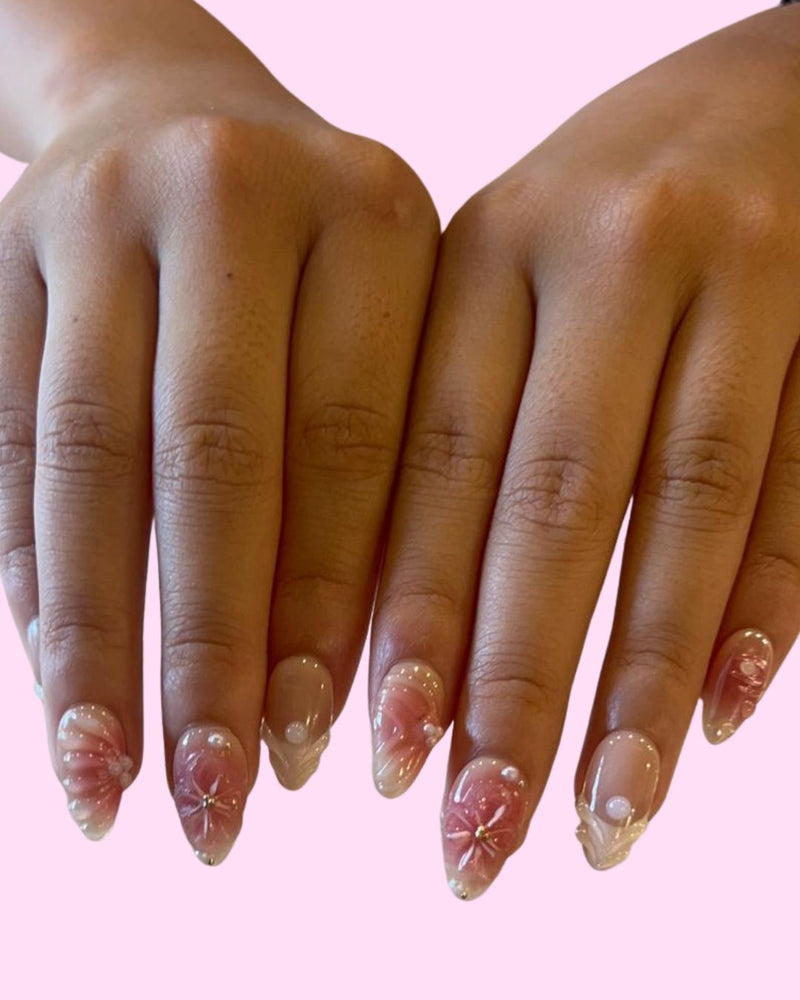
Let us know your email address
You're in! 🎉
Check your inbox for your 10% off code.


Almond and coffin are the two shapes most people choose between, and the decision is usually made on a photograph of someone else's hands. That is why so many sets end up unworn.
Shape does more for how your hands look than colour does, and the right one depends on your finger length, your nail bed width and what you do all day. Here is how to work out which is yours — and the short answer, for most people, is almond.
Almond tapers from the sidewalls to a rounded, slightly pointed tip — the shape of the nut. Soft, elongating and the most flattering shape available for the majority of hands.
Coffin (also called ballerina) tapers the same way but stops at a flat, squared-off tip. Structured and modern. It needs length for the taper to make sense.
They are close relatives — the only difference is what happens at the tip — but they read completely differently on the hand.
| Almond | Coffin | |
|---|---|---|
| Tip | Rounded, softly pointed | Flat, squared |
| Minimum length to work | Medium (5 mm+) | Medium-long (8 mm+) |
| Effect on fingers | Lengthens and slims | Lengthens, more structured |
| Suits wide nail beds | Yes — the taper narrows them | Yes, at length |
| Suits short fingers | Best option available | Only at longer lengths |
| Durability | Good — no corners to catch | Lower — corners are stress points |
| Catches on clothing | Rarely | More often |
| Surface for art | Moderate | Largest of any shape |
| Reads as | Elegant, timeless | Bold, current |
Short or average fingers. Almond, clearly. The taper draws the eye to a point and the visual line continues past where your finger actually ends, which lengthens the whole hand. Coffin's flat tip does the opposite — it cuts the line off abruptly, and at anything less than a long length it can make short fingers look stubbier.
Long fingers. Either works, and this is the case where coffin genuinely earns consideration. Long fingers can carry the structure without looking out of proportion, and the flat tip balances a slender hand.
Look at your nails straight on. Are they noticeably wider than they are long?
Wide nail beds. Both shapes help, because both taper. Almond helps more at shorter lengths — the taper begins closer to the base. If you want coffin on a wide bed, you need length, or the result reads as a wide rectangle rather than a taper.
Narrow nail beds. Almond can look very pointed on an already-narrow nail. Coffin, or a softer oval, keeps more width at the tip and balances better.
This is where coffin loses most often, and it is worth being blunt about it.
A flat tip has two corners, and corners are stress points. They catch on jumper sleeves, coat pockets, car door handles and the inside of bags. Every catch is a small lever acting on the glue bond. Almond has no corners, so there is nothing to catch — which is why almond sets reliably outlast coffin sets on the same hands.
If you type all day, handle small children, work in hospitality or go to the gym, that difference is not theoretical. It is the difference between a set that lasts three weeks and one that loses a nail in the first week.
Coffin's whole effect depends on a visible taper ending in a clean flat tip. At short lengths there is not enough room for the taper to develop, so you get a small rectangle. Coffin really starts working from about 8 mm of free edge.
Almond works from about 5 mm and keeps working all the way up. That flexibility is a large part of why it is the most-bought shape — you can wear almond press on nails at a length appropriate for work and still get the elongating effect.
Before choosing an artificial shape, it helps to know what you are starting from, because the most natural-looking result follows the shape of your cuticle line.
Push your cuticles back and look at the curve at the base of the nail, not the tip. That curve is fixed — it is the shape of your nail matrix — and it comes in roughly four forms.
This matters because a shape that fights your cuticle line will always look applied. A shape that extends it looks like your own nails, only better — which is what most people are actually after.
A detail that separates a good almond set from a cheap one, and it explains why two sets sold as "almond" can look completely different on the same hand.
On a well-made almond the taper begins roughly at the point where your natural nail leaves the finger, and narrows smoothly to the tip. The eye reads one continuous line from cuticle to point.
On a cheap moulded set the taper often starts too far forward — the nail runs straight for most of its length, then narrows abruptly near the end. The result is a rectangle with a point stuck on it, and it reads as artificial from across a room even when the finish is perfect.
You can see this in a product photograph if you look at where the sides start converging. It is also why hand-finished sets cost more: getting the taper to start in the right place means filing each nail individually rather than accepting what came out of the mould.
A practical note, since people often want to try the other one.
Coffin to almond is possible with a file. Round the two corners down and continue the taper to a soft point. Ten minutes for a set, and the result is decent because you are removing material from a shape that already tapers.
Almond to coffin is not possible. You would need to add width back at the tip, and there is nothing to add. If you want coffin, buy coffin.
This asymmetry is worth knowing when you are deciding what to order. Almond is the more flexible purchase — you can wear it as bought, shorten it, or soften it toward oval. Coffin is the more committed one.
Answer these four and the shape picks itself.
Three or more pointing to almond means buy almond. That will be most people, which is not a marketing line — it is why almond outsells every other shape.
Almond suits solid neutrals, a fine French, chrome and milky finishes. The taper is the feature, so the finish should support it rather than compete. Busy art fights the shape.
Coffin has the largest flat surface of any shape, which makes it the best canvas for art — gradients, marble, encapsulated detail. If you want a design to be the point, coffin gives it room.
Shape carries a register, the way a haircut does, and it is worth choosing deliberately rather than by accident.
Almond reads as timeless. It has been in continuous use for decades without ever being the trend of the moment, which means it does not date. It is the shape that looks appropriate on a lawyer, at a wedding, in a family photograph you will still be looking at in fifteen years. If you want your nails to look considered rather than fashionable, this is the one.
Coffin reads as current. It arrived with the long-nail era and it still carries that association — deliberate, bold, aware of what is in. That is a genuine strength if it is the effect you want. It also means coffin sets photograph as belonging to a particular period in a way almond does not.
Neither register is better. But if you are buying one set to cover a wedding, work and everything in between, almond is the safer purchase, and if you are buying something to make a statement at a specific event, coffin does that job better.
Almond, for most people. It lengthens short and average fingers, narrows wide nail beds, and works at shorter lengths. Coffin is more flattering specifically on long fingers at longer lengths.
Almond. Coffin's flat tip has two corners that catch and lever, which is the commonest way a nail comes off early.
Yes — the same shape, named either for a coffin outline or a ballet shoe. Different sellers use different words.
You can, but the taper does not have room to develop and the result reads as a small rectangle. Below about 8 mm, almond or squoval look considerably better.
Almond at any length, or coffin if you are going long. Both taper, which narrows the nail visually. Avoid wide square shapes, which emphasise the width.
Almond. The taper carries the visual line past the end of the finger. A flat tip cuts it off.
For most people that is almond at medium length — flattering on nearly every hand, durable enough for daily life, and appropriate everywhere from a desk to a wedding.
Handmade, reusable, dispatched from Australia. Measure your nails before ordering — shape only works when the fit does.