Handmade vs Mass-Produced Press On Nails: How to Tell the Difference
How to spot a handmade press on set versus a factory multipack: finish quality, cuticle...
Read more ›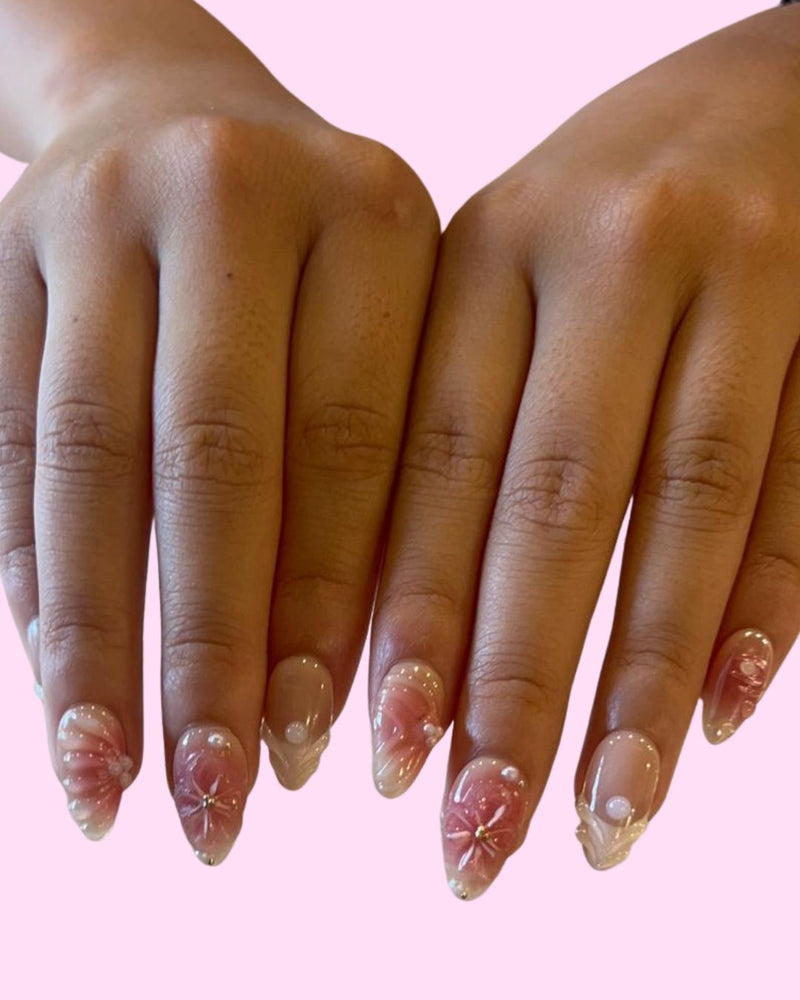
Let us know your email address
You're in! 🎉
Check your inbox for your 10% off code.


Short press on nails are the set most people actually wear. Long sets get bought for the photograph; short sets get worn on a Tuesday, and again the Tuesday after that.
They are also the most forgiving length to apply, the hardest to knock off, and — done properly — the most expensive-looking. Here is how to choose a short set that reads as deliberate rather than stubby, and how to wear it.
Length is measured as free edge — the part extending past your fingertip — not the whole nail.
| Length | Free edge | Reads as |
|---|---|---|
| Natural / bare | 0 – 2 mm | Groomed, no extension |
| Short | 2 – 5 mm | Deliberate, polished, work-appropriate |
| Medium | 5 – 9 mm | Noticeable, still practical |
| Long | 9 mm+ | A statement |
Short is the two-to-five millimetre band. Enough to change the shape of your hand and hold a proper finish, not enough to interfere with anything you do.
Square with the corners softened. The most wearable shape there is — the flat tip gives you a wide surface for colour, and the rounded corners are what stop it catching on jumper sleeves and car doors. If you type all day, squoval press on nails are the obvious choice.
Follows the natural curve of your fingertip. The most understated option and the one least likely to be read as artificial. Particularly good on wider nail beds, where it softens the shape.
A gentle taper with a rounded tip. Slightly more done than round or squoval, and it visually lengthens shorter fingers. The taper needs a few millimetres to read properly, so this works at the upper end of short rather than at 2 mm.
Straight across with barely-eased corners. Crisp and modern, and the best shape for a micro French because the tip line stays clean. Slightly more prone to catching than squoval.
What does not work short: stiletto and coffin. Both need length for the taper to make sense, and at 3 mm they just look like a filed-down mistake.
Short nails have less surface area, so the finish carries the whole look. Busy art shrinks badly; quality of finish shows more.
What to avoid: large florals, multiple accent nails, and anything with several elements competing. Our classic collection is built around the finishes that hold up at this length.
For most of the last decade, length was the point. Long coffin and stiletto sets dominated everything, and a short nail read as a nail you had not got around to doing.
That has reversed, and for reasons that are more practical than fashionable. People went back to offices and keyboards. The "clean girl" and quiet-luxury aesthetics put the emphasis on finish quality rather than scale. And a generation that grew up with long acrylic got tired of the maintenance and the fingernail-shaped limitations on ordinary tasks.
What replaced it is a short nail with an immaculate finish — which is, if anything, harder to get right. A long nail carries a look through sheer presence. A short one has nowhere to hide: the shape has to be even, the cuticle line clean, the colour flawless. That is why a well-made short set looks so much more expensive than a cheap long one, and why short is where handmade quality shows most.
With less surface area, shade selection is doing more work than design, so it is worth getting right.
Cool undertones — if the veins at your wrist look blue and silver jewellery suits you — work with pinkish nudes, rosy beiges, milky whites, berry and blue-based reds. Avoid yellow-toned or orange nudes, which can look sallow against cool skin.
Warm undertones — greenish veins, gold jewellery suits you — work with caramel, peachy and golden nudes, terracotta, warm reds and chocolate. Very cool greys and blue-pinks tend to look ashy.
Neutral undertones can wear almost anything, which is genuinely convenient rather than a compliment.
The universal rule, regardless of undertone: pick a nude one or two shades deeper than your skin, not lighter. Lighter than your skin washes the hand out and makes the nail look shorter. Slightly deeper defines the nail and extends the finger.
If short is going to be your default, three sets covers a year comfortably.
Each worn a few times across the year, that is under $120 for a year of nails, and it covers essentially every situation you will be in.
Most Australian workplaces have no written rule about nails, but there are settings — healthcare, food handling, some labs, childcare — where length is genuinely restricted, and a few client-facing roles with an unspoken conservative standard.
Short sets in nude, milky, sheer pink or a fine micro French pass essentially anywhere. They read as grooming rather than decoration, which is the distinction most workplaces are actually drawing. If your role has a hard rule about artificial nails, that rule generally covers press ons too — worth checking rather than assuming.
Short sets are more forgiving, but two things matter more, not less.
Width accuracy. With less length, there is less nail to grip with, so full sidewall-to-sidewall contact is doing more of the work. A nail a size too narrow will lift. Size up and file the sides down — our size guide has the method.
Cuticle placement. On a short nail, a millimetre gap at the base is proportionally much more visible. Push the cuticle back properly and seat the nail close to it.
Everything else is easier: less leverage means less stress on the bond, so short sets routinely outlast long ones. Our application guide covers the full process.
Yes. Less leverage means less stress on the glue, so they hold better, and there is no adjustment period for typing or phones.
Squoval for most people — wearable, hard to catch, and it suits nearly every hand. Round for wider nail beds, short almond if you want a little more length in the look.
In most roles, yes. Short sets in nude, milky or micro French read as groomed rather than decorative. Healthcare and food handling roles often restrict artificial nails outright — check your own policy.
Generally, yes. There is less leverage acting on the bond, so fewer nails get knocked off.
Leave the sidewalls slightly bare, choose a shade close to but deeper than your skin tone, pick a soft taper over a wide square, and keep the cuticle area clear.
You can shorten it, but you cannot move where the shape's taper starts. A shortened coffin reads as a coffin with the point removed. If you want short, buy short.
Very well. Round and squoval both soften a wider nail, and leaving the sidewalls slightly bare narrows it visually. Size up and file the sides back for a proper fit.
Squoval or round, 2 – 5 mm, in a nude, milky or micro French finish. It goes on in fifteen minutes, holds for weeks, and works at your desk, at the gym and at dinner.
Handmade, reusable, and dispatched from Australia. Measure your nails first — width matters more at this length than any other.