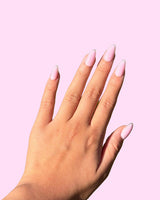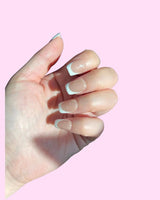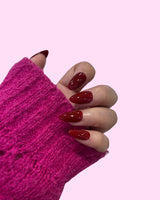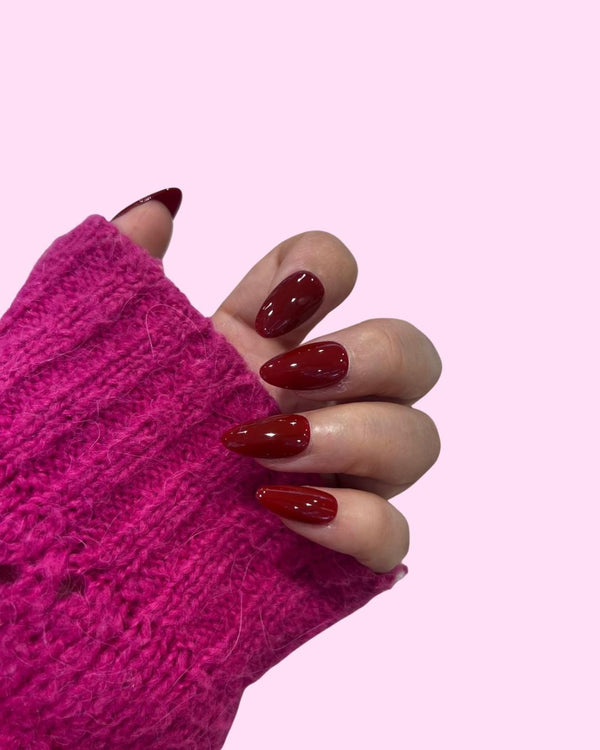
Date Night Nails: Ready in Five Minutes
Date night nails should feel special without taking your whole afternoon. Press ons go ...
Read more ›

A set of press on nails should hold for weeks. If yours are coming off in days, something specific is causing it — and in almost every case it is one of nine things, all fixable.
New here? Aurelle Beauty makes handmade press on nails that go on in about 5 minutes and are reusable with careful removal.
Work through this list in order. The first three account for most failures.
The single commonest cause, and the one people least suspect because the nail looked fine going on.
A press on that does not reach your sidewalls leaves a channel down each side. Water, soap, hand cream and sunscreen run into it and sit against the glue, softening the bond from the outside in. That is why undersized nails fail on a schedule — usually day three, not day one.
The fix: choose by width, not length. If you are between sizes, take the larger and file the sides back. Too big is a two-minute filing job; too small cannot be corrected. Our guide to fixing the fit covers it, and the size guide has the measuring method.
Natural nail oils are the enemy of cyanoacrylate glue. Even a nail that looks and feels dry carries enough oil to halve the bond strength.
Hand cream is worse. Applying it an hour before a set, or having it on your hands while you work, contaminates the surface invisibly.
The fix: wipe each nail with rubbing alcohol immediately before applying and let it air dry completely — thirty seconds, not blotted with a towel. This one step fixes more early lifting than any other.
Glue needs texture to grip. A naturally glossy nail plate gives it very little.
The fix: three or four light passes with a fine buffer, just enough to take the shine off. You are dulling the surface, not removing a layer — if the nail feels warm, you have gone too far.
Counter-intuitive, and extremely common. Excess glue squeezes out when you press, pools at the cuticle, and prevents the base of the nail from seating flush. That leaves a raised edge at exactly the point where peel force starts.
Thick glue also cures unevenly, leaving soft spots inside the bond.
The fix: a thin layer on the natural nail, a smaller dot on the press on. If glue appears around the edges when you press, you used too much. Wipe it off before it sets.
Nail glue grabs in seconds but does not reach strength for considerably longer. Placing a nail and moving straight to the next one leaves every bond half-set.
The fix: press firmly for a full 10–15 seconds per nail, counting. Then leave your hands alone for at least ten minutes — no washing up, no hair, no phone case.
An overgrown cuticle stops the nail seating close to the base. The resulting gap is both visible and a starting point for lifting, and it means less contact area at the strongest part of the nail.
The fix: push the cuticle back gently with a wooden stick before you start. Do not cut it — the cuticle seals the gap between nail and skin, and cutting it opens a route for bacteria.
Looked at end-on, a press on should curve across its width to match your nail bed. A flatter nail makes contact only in the middle, which can halve the effective bond area even when the width is right.
This is largely a product problem. Cheap moulded sets are flat because flat releases from a mould easily. It is why handmade sets hold better.
The fix: squeeze the nail gently from the sides while the glue sets to encourage it to conform. If a whole set rocks in the middle, the set is too flat for you.
Hot water is the steady enemy — long baths, hot showers and washing up without gloves all soften a cyanoacrylate bond over time. Sunscreen is the acute one: the oils migrate under the free edge and get straight into the bond.
The fix: gloves for washing up and anything with a long soak. Rinse hands after applying sunscreen. Neither means avoiding water — showering and swimming are fine — but prolonged hot soaking is what shortens wear.
Shapes with corners catch. A caught corner applies peel force to the edge of the bond, which lifts it, and a lifted edge never re-seals — the next catch peels further.
This is why square and coffin sets come off earlier than squoval or almond on the same hands with the same glue.
The fix: round the corners a little more with a file before applying. If you consistently lose nails, switch shapes.
Understanding this makes the nine causes above make sense as a group rather than a list.
Nail glue is strong against a straight pull — considerably stronger than most people expect. A properly bonded press on will not come off if you simply try to lift it away from the nail. What it is weak against is peel: force applied to one edge, lifting it while the rest stays down.
Peel needs a starting point. That is what every cause on this list produces: a sidewall gap from an undersized nail, a raised edge from excess glue at the cuticle, a corner that catches on a sleeve, a patch of weak bond where oil sat on the plate. Once any edge lifts by half a millimetre, it does not re-seal. It becomes a lever, and every subsequent knock peels a little further.
This is why nails so often come off at apparently random moments, days after the event that actually caused it. The catch on Monday started the peel; Wednesday's ordinary hand-washing finished it.
It also explains why prep matters more than glue quality. A stronger adhesive applied over an oily patch still has a weak spot to peel from. Eliminating starting points is what keeps a set on, not brute bond strength.
Two less obvious causes worth checking if the nine above do not explain it.
Old glue. Cyanoacrylate degrades once opened. A tube that has been in a drawer for a year — particularly one stored somewhere warm — will be noticeably weaker and may have thickened. If your glue strings or feels gluggy, replace it. A fresh tube costs under $15 and is the cheapest possible fix.
Warped nails. Press ons stored loose in a drawer, or left somewhere hot like a car, can distort. A nail whose curve no longer matches your nail bed will make contact in fewer places, whatever the width. Store sets flat in their original tray, out of direct sun.
Both of these show up as a whole set underperforming rather than individual nails failing, which is the tell that distinguishes them from a prep problem.
The pattern tells you the cause.
| Pattern | Most likely cause |
|---|---|
| One specific finger, every time | That nail is the wrong size — usually thumb or index |
| Index fingers first | Normal contact wear; consider a shorter length |
| All ten within 48 hours | Prep — oil or no buff |
| All ten around day three | Sizing, water ingress at the sidewalls |
| Lifting at the cuticle end | Too much glue, or cuticle not pushed back |
| Lifting at one side only | Too narrow, or glue did not reach that edge |
| Dominant hand only | Normal — consider shorter on that hand |
Do it promptly. A lifted nail traps moisture against the nail plate, which is the one genuine hygiene risk in wearing press ons.
Never add glue around the edges of a nail that is still attached. It sits against your skin, forms a ridge that catches on everything, and makes eventual removal harder.
Our application guide has the full detail.
Up to four weeks with glue on a properly prepped nail. Under a week means a prep or sizing problem, not a faulty product.
Hot water softens the bond, and undersized nails let it reach the glue through the sidewall gap. A properly-fitted set handles ordinary showering without trouble.
No, the opposite. Excess glue stops the nail seating flush and cures unevenly. A thin layer holds better.
That nail is the wrong size for that finger. Try the next size up and file it to fit.
Not advisable. Nail glue is formulated for skin contact and for removal by soaking. Hardware adhesives are not, and removing them tends to take nail with them.
Some growth at the cuticle is normal and expected. Lifting at the sides or free edge is not — that is water ingress and the nail should be reattached.
No, and they are not meant to. Tabs are for a day or an evening and come off easily by design. If you want weeks of wear, use glue.
Prolonged immersion plus chlorine or salt, usually combined with sunscreen. Rinse and dry your hands afterwards, and expect a shorter wear from any beach or pool week.
Losing one occasionally is ordinary wear, especially on a thumb or index finger. Losing several within a few days points to prep or sizing.
Most early lifting is sizing and prep. Start with a set that has enough sizes to actually fit you, and the four-minute prep does the rest.
Check the size guide and measure the widest point of each nail before you order.
Ready to try a set? These are popular picks from our range:
Date night nails should feel special without taking your whole afternoon. Press ons go ...
Read more ›
Baby shower nails are all about soft pastels and sweet details, whether you're the gues...
Read more ›
The right nail shape can make fingers look longer and slimmer. Here's what works best f...
Read more ›Shop the sets in this guide
Free AU shipping over $99
 Ballet – Handmade, Extra Short Squoval
 Scarlet Silk – Handmade, Extra Short Squoval
★ 10,000+ reviews · Handmade · Ships from Australia
Watch
Handmade vs Factory Press On Nails: Can You Tell?